Tobacco Pack Surveillance System in Pakistan

Background
In 2017, Pakistan had a population of 192.8 million people; 12.4 percent of the adult population and 10.7 percent of the youth population smoked tobacco products. An estimated 128,588 people died in Pakistan in 2017 from diseases caused by smoking.
To reduce the burden of disease, the Pakistan government implemented a requirement in 2010 for 40% pictorial health warning labels (HWLs) that depicted mouth cancer. A 2017 ruling to increase HWL size was implemented in August 2018 (50% throat cancer image) and August 2019 (60% gangrenous foot image).
Method
From November 25 to December 4, 2013, TPackSS worked with in-country collaborators to purchase cigarettes and bidis in three major cities: Islamabad, Karachi and Lahore. Within each city, packs were collected from a sample of 12 economically and socially diverse neighborhoods. Data collectors purchased one of every unique cigarette and bidi pack available from vendors selected in each neighborhood. Data collectors purchased 394 unique cigarette (n=382) and bidi (n=12) packs.
In December 2019 and January 2020, another pack collection was undertaken. During this collection, in-country collaborators purchased cigarettes, bidis, and smokeless tobacco products in five major cities, the three that were previously visited, along with Peshawar and Quetta. Data collectors purchased 185 unique packs (174 unique cigarette, 3 unique bidi, and 8 unique smokeless tobacco packs).
The tobacco packaging and labeling requirements in effect at the time of data collection were used to assess each tobacco pack’s compliance with the requirements.
HWL Compliance
In 2013, 310 (81%) total packs had no HWL or a non-Pakistani HWL (n=310) and 5 (1%) had a previous Pakistani HWL (n=5). Only 67 (18%) of total packs had a current mandated HWL. This 2013 sample included 39 (58%) of unique packs with the current, in-rotation HWL were compliant with size, location, text contrast and text size requirements in Pakistan.
Of the 174 packs purchased in 2019/2020, 34 (20%) had the current HWL. 82% of the 34 unique cigarette packs assessed were compliant with all 3 key HWL requirements. 85% of these packs had the correct size warning and 97% of them had the warning on the top edge of the pack. All of these 34 packs had health warning text in Urdu and English.
HWL Manipulation
For the 72 packs with a Pakistani HWL in the 2019/2020 collection, the HWL quality was evaluated. The law clearly states that the HWL be ‘printed in the exact color, intensity and clarity’ as the HWL provided by the government. However, a number of unique sample packs differed from the official images. Manipulations were observed in HWLs of all types and by both international and domestic manufacturers.
The manipulations observed included tinting, darkening, fading, changing the background color from blue to grey, cropping the HWL, blurring, brightening and increasing the color saturation or reducing the size of the throat cancer. Tinting (n=49, 68%), darkening (n=32, 44%) and fading (n=28, 39%) were the most common manipulations.
Some packs were also observed with multiple types of manipulations, such as red tint and a grey background. Of note, HWLs tinted to the color of the pack and HWLs with no apparent cancer appeared in our sample, indicating intentional manipulation of the HWL by the tobacco industry. Examples of the most egregious manipulation include those from National Tobacco Industries AJK (Gold Street), Souvenir Tobacco Co Ltd (Melburn, Badsha), Sultan Tobacco Co (Pvt) Ltd (Jump), and Progressive Cigarette Industries (Pvt) Ltd AJK (Town).
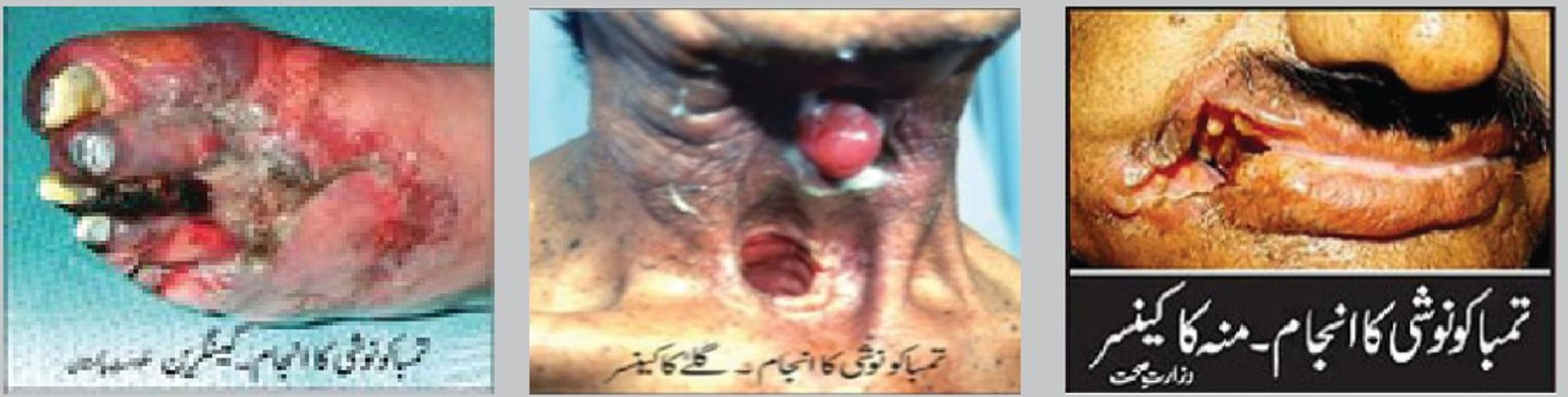 |
From left to right, HWL images as intended: 2019 60% HWL, 2017 50% HWL, 2010 40% HWL. |
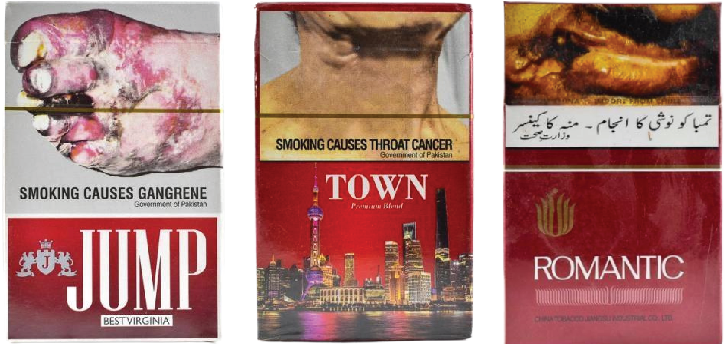 |
From left to right, manipulation via lightening the image, cancer spots removed |
Illegal/Illicit Packs
In the 2019/2020 collection, we found 140 packs (80.5%) without a current Pakistani HWL. 18 packs with the former 50% throat cancer HWL; 11 out of 18 (61%) were from local companies, while the remaining 7 packs were from PMI, BAT, and ITC. 20 packs with the former 40% mouth cancer HWL; 11 out of 20 (55%) were from local companies, while the others were from PMI, BAT, and CNTC.
Our collection included 93 packs with a non-Pakistani HWL and 9 without a HWL. These illicit packs included brands from PMI (Marlboro, L&M, K2, Parliament), BAT (555, B&H, Dunhill, Pall Mall), Imperial (West, Davidoff), JTI (Camel, Hi-Lite, More, Sobranie, Winston), and KT&G (Cima, Essa, Pine, Raison, Eighty Eight).
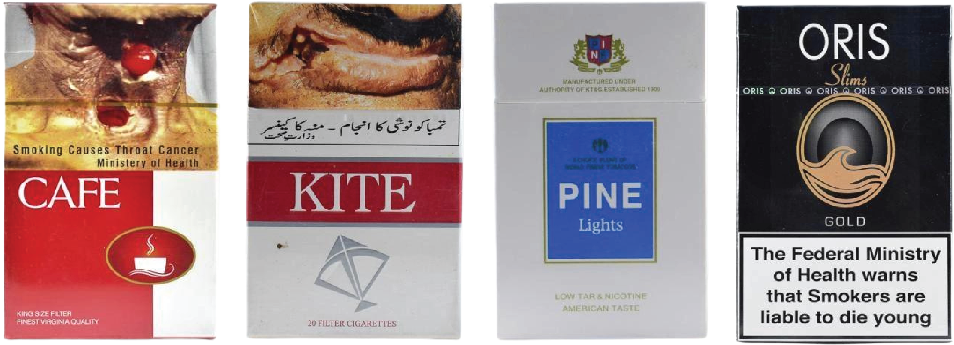 |
From left, the old throat cancer HWL, the old mouth cancer HWL, no HWL and a foreign HWL. |
Discussion and Conclusion
Despite efforts in Pakistan to address high smoking rates through the implementation of pictorial HWLs, it is clear that the tobacco industry is manipulating HWLs. This cannot be considered a printing issue as other elements of the packs (e.g., logos, backgrounds) did not display the same quality issues. HWL manipulation was previously documented for smokeless tobacco products in India.
Since pack collection only took place in cities, further research could explore if these manipulations are also present in other areas of Pakistan. Improved monitoring, enforcement and alignment with FCTC penalty provisions are needed to maintain the integrity of mandated HWLs and ensure that illicit packs are not available and former HWLs are removed from shelves to deter youth initiation, increase quit intentions and prevent relapse in former smokers.